Frequently Asked Questions
What is NetQ Systems?
NetQ is an app available on iOS and Android which bills you for a combination of utilities which includes electricity, water, sanitation/sewerage, and the energy component of hot water.
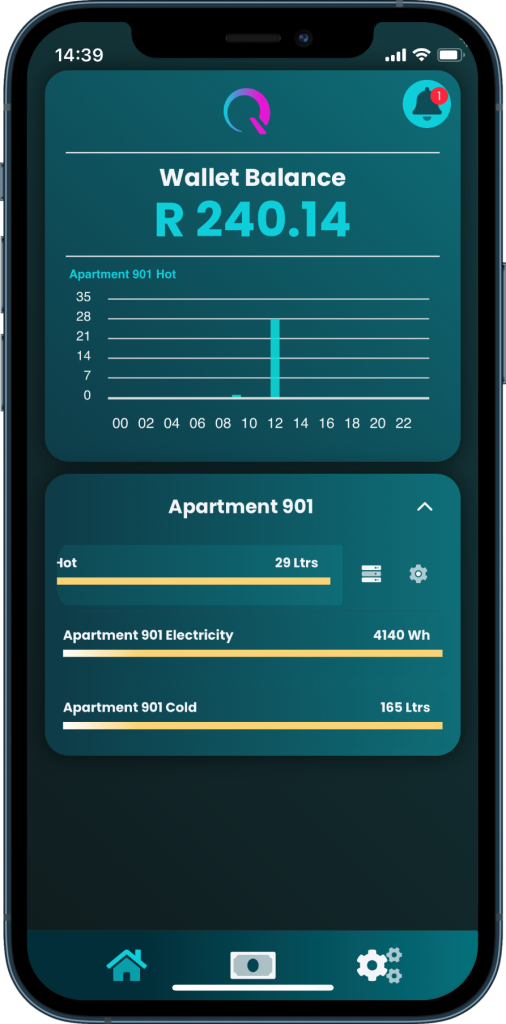
The App has a smartwallet incorporated into the application, this wallet needs to continuously have funds which will be used to purchase prepaid electricity and pay for the other utilities which include water, sanitation, and hot water. These funds once depleted must be topped up.
How can I top up my wallet?
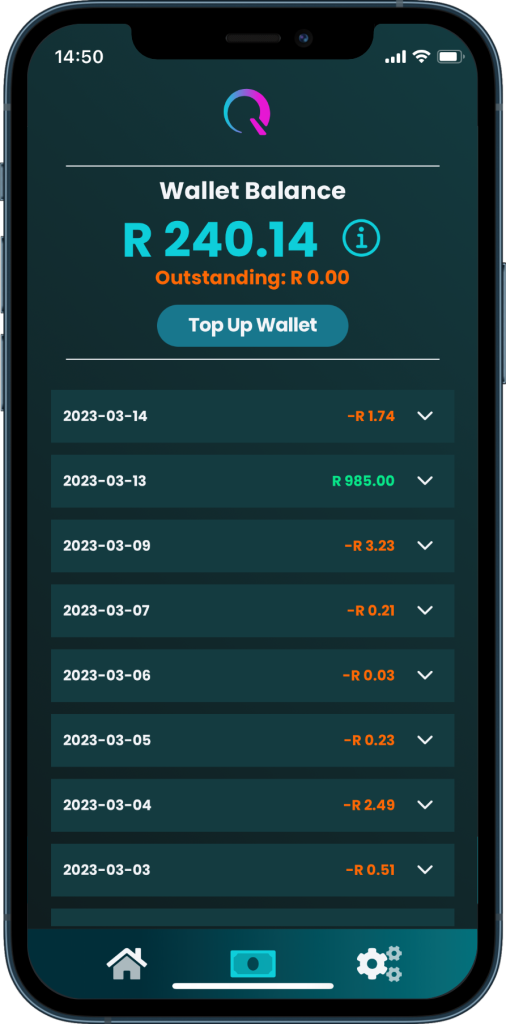
To add funds to your wallet, you can top up indicating the value you want to top up with by selecting either Ozow which is linked to your bank account to facilitate an instant EFT or Yoco which requires a VISA or MasterCard bank card. This will ensure the most timeous reflection of funds.
Why am I being charged a percentage when topping up my wallet?
We have selected our payment gateway providers due to their competitive rates, which balance affordability with exceptional security and quality of service. The percentage fee applied when topping up your wallet is associated with the transaction costs incurred through this provider, enabling us to maintain a secure and reliable payment processing system for your convenience.
What value should I top up my wallet with or should I always ensure there are funds available?
Ideally you should always have funds available but the top up is relevant and dependent on how much you use. As a benchmark it is suggested that an initial R500 be deposited, and this monitored to see how much you use. Please bear in mind the initial prepaid electricity purchase is approximately R200. On average, an apartment would use approximately R1000 a month for water and electricity. These figures are not set in stone and are dependent on the usage.
What can I see on NetQ Systems?
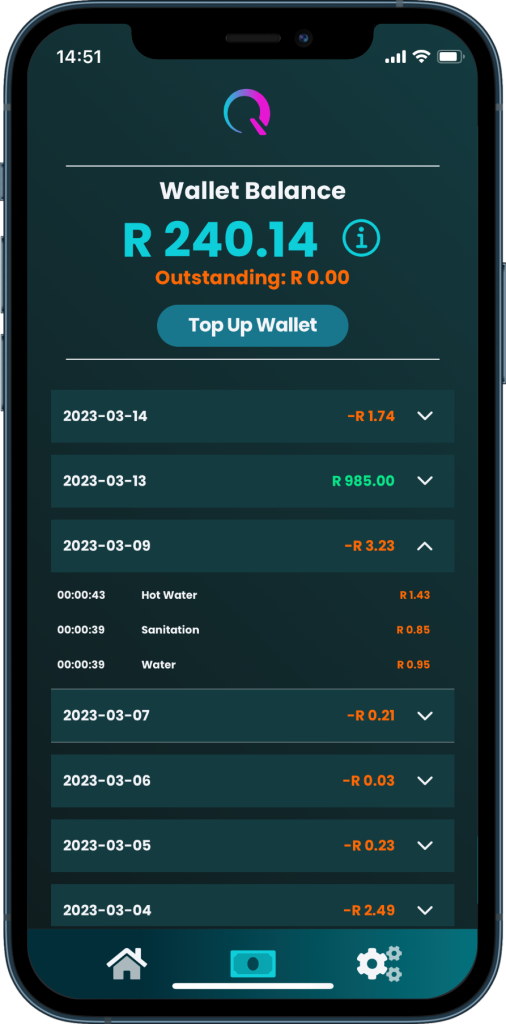
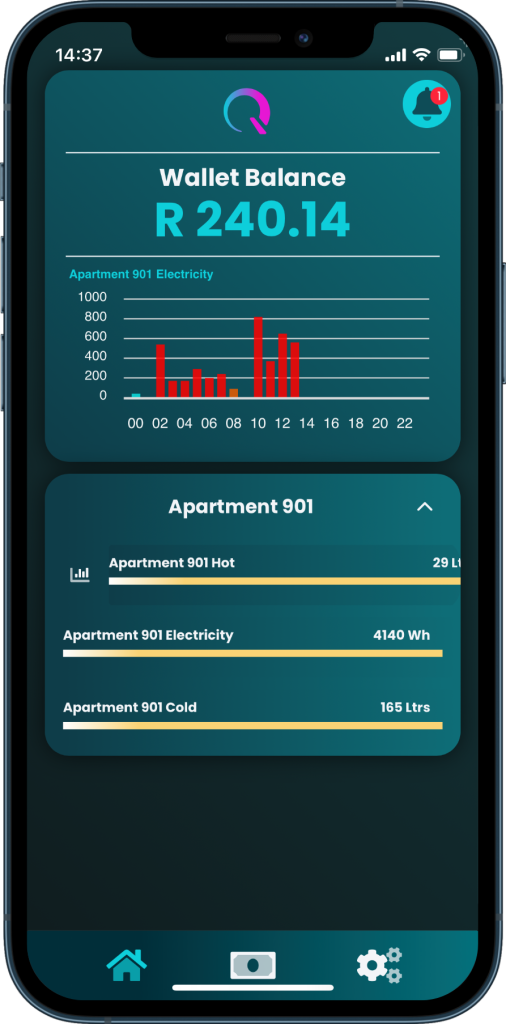
NetQ will show the money available in the wallet and the various entries for the different charges being billed. These are shown on the second page of the App. These charges are for electricity, water, sanitation, and energy. Each day has a drop-down page showing values for water, hot water, and sanitation.
I topped up my wallet but by balance is zero – how could I have used so much electricity that fast?
Firstly, check your deductions. This will indicate for what your funds were used. If you see electricity purchased, please note that the funds have been used to purchase prepaid electricity. Therefore, you have not used this electricity yet, but you will have this amount of electricity available as a prepaid value to drawn down on.
What are the values in outstanding?
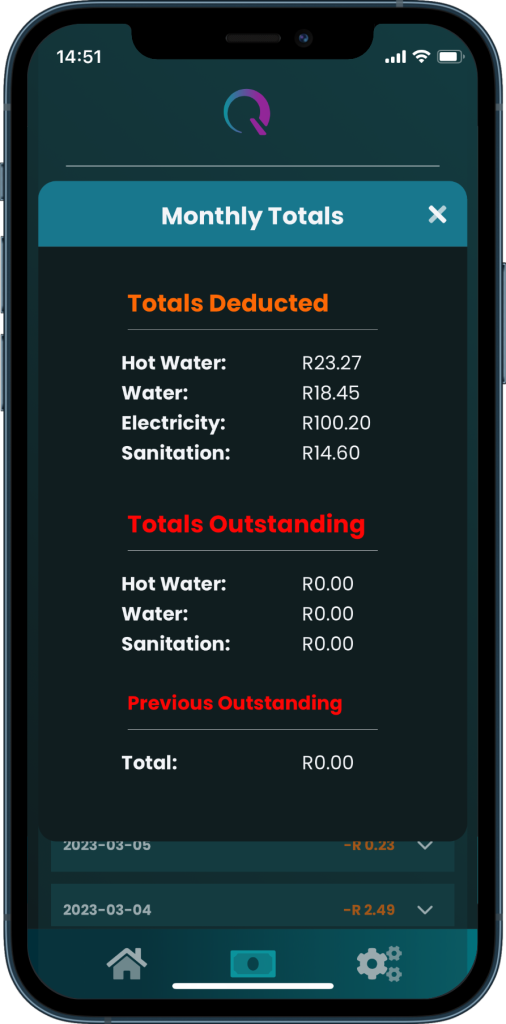
Values in outstanding are deductions related to water, sanitation and hot water incurred during the period when there were no funds in the wallet available to be deducted from. These values will be recouped when the wallet is topped up.
Will my electricity be cut off if I have a wallet balance of R 0?
Your meter will only be cut off when the prepaid credit balance reaches 0 kWh. Therefore, your electricity will not immediately switch off if you have no funds in the wallet. The system automatically tries to top up once you have reached 35 kWh by deducting off the wallet funds. If there are no funds in the wallet it will not be able to top up and your credit balance on the meter (35 kWh) will reduce. If you do not top up your wallet balance within this period of usage (35 kWh) the meter will run out of credit and switch off once it reaches 0 kWh. When you top up your wallet, the system will automatically use your funds to buy prepaid credit for your meter.
Can I see what I use on NetQ Systems while I am using that facility, in real time?
NetQ shows the day’s usage, within a few hours of the consumption. It does show the usage according to the time it was used within reasonable reporting times.
How does the billing work?
Nothing is free! Billing is split into two methods.
1: Electricity is prepaid – the App buys prepaid credit (so you are buying a certain amount of units/kWh in advance). When this amount gets to zero your electricity will be cut off.
2: Water, sanitation, and hot water are post paid – you will receive a daily deduction off your wallet which will be related to the previous day’s usage. This is usually calculated in the early hours of the morning but is related to the previous day’s usage. Billing does not take place at the same time usage takes place, water / hot water and sanitation take place the next day (runs during the night).
The App has a smartwallet incorporated into the application, this wallet needs to be topped up with funds which will be used to purchase prepaid electricity and pay for the other utilities which include water, sanitation, and hot water.
Where is the physical keypad for my prepaid electricity meter?
NetQ systems uses the latest technology to remotely monitor and manage your prepaid meter, allowing the full management of your electricity meter from your phone via the App and therefore no need for a keypad (CIU). Your prepaid meter will automatically top up credit when it reaches its low threshold, it generates the token when deducting off the wallet and it remotely loads this token onto your prepaid meter.
Can I buy prepaid electricity from a retail outlet (like Pick n Pay)?
No, you cannot buy prepaid electricity from a retailer, as the system is automated and the token for prepaid electricity is managed within the wallet and App.
What billing structures are followed?
All billing is done in line with City of Cape Town tariffs and is constantly amended in line with adjustments made by City of Cape Town.
Electricity – current cost per kWh is R 3.91 for the first 600 kWh and increases to R 4.76 per kWh if you go higher than 600 kWh in the month.
Water and Sanitation use a step tariff system which is how the City of Cape Town calculates water charges. For the first 6000 litres of water, you pay R 22.50 per 1000 litres then it gets to a rate of R 30.96 per 1000 litres (once you exceed 6000 litres).
Sanitation follows the same process as water, 90% of your water usage is allocated to sanitation with its own City of Cape Town tariff structure. Your month to date sanitation would therefore be 90% of your water usage.
Water
| Block Number | Block Limit | Block Charge |
| 1 | 6 kl | R22.52 |
| 2 | 10.5 kl | R30.96 |
| 3 | 35 kl | R42.07 |
| 4 | > 35 kl | R77.63 |
Electricity
| Block Number | Block Limit | Block Charge |
| 1 | 600 kWh | R3.91 |
| 2 | > 600 kWh | R4.76 |
Sanitation
| Block Number | Block Limit | Block Charge |
| 1 | 4.2 kl | R19.80 |
| 2 | 7.35 kl | R27.20 |
| 3 | 24.5 kl | R38.20 |
| 4 | 35 kl | R60.09 |
Can I see how much water, electricity, and sanitation I have used?
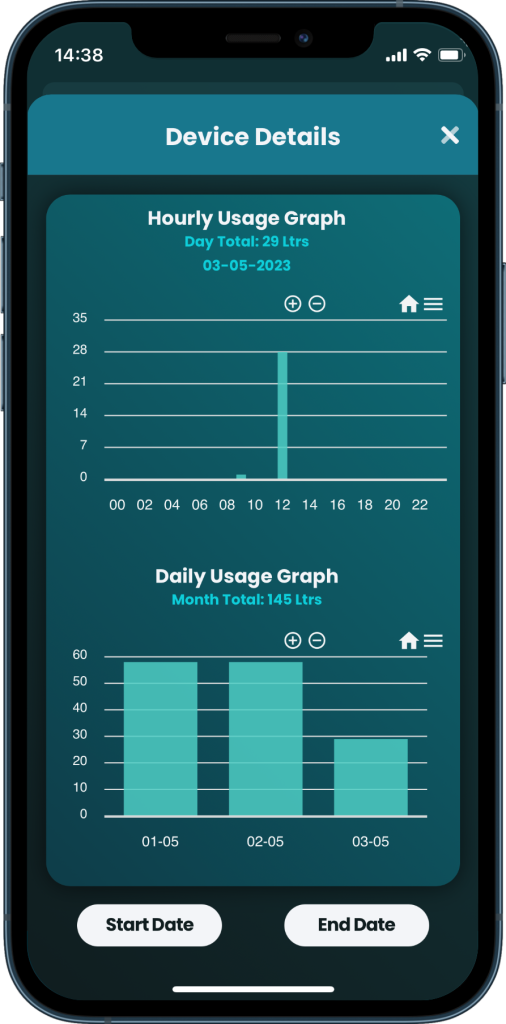
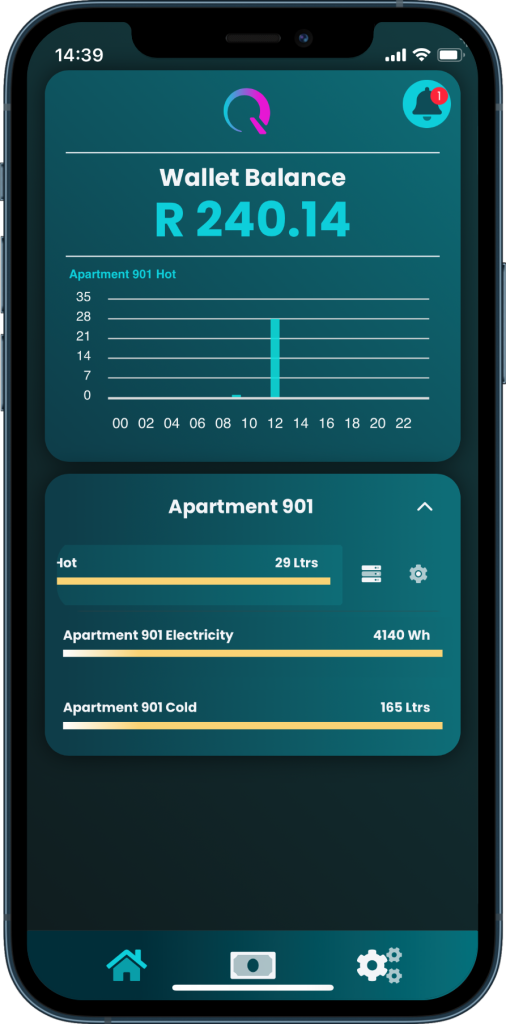
By selecting the utility, and sliding the slider to the right, a graph icon will appear which when you click, you can view usage based on dates selected. The bottom graph will show the daily usage, the top graph will show by the hour.
Is it possible to set a notification to maximum usage per day?
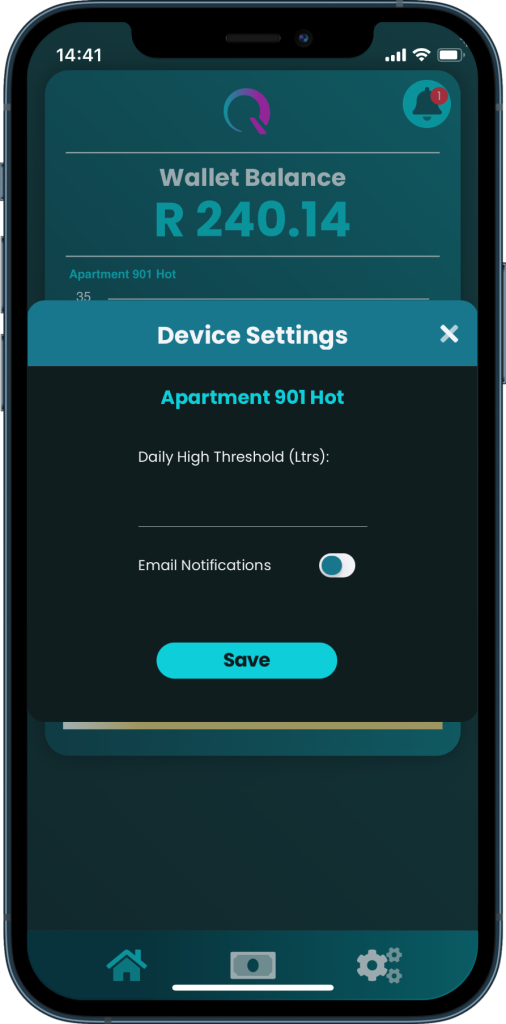
By selecting the utility, and sliding the slider to the left, a settings icon will appear which when you click, you will be able to set up alarms for high usage which will send a notification when the threshold is reached.
Why is this system in place and not the traditional prepaid meter?
Smart prepaid electricity meters have several benefits, including:
1: Control over energy usage: With a smart prepaid meter, consumers can monitor their energy usage and adjust their consumption accordingly, which can help them save money on their energy bills.
2: No more estimated bills: With a smart prepaid meter, customers pay for the electricity they use in real-time, which eliminates the need for estimated bills.
3: Accurate billing: Smart prepaid meters measure energy consumption accurately, ensuring that customers only pay for what they use. This eliminates the risk of overbilling or underbilling.
4: Convenience: Smart prepaid meters allow customers to top up their electricity credits online or through mobile apps, eliminating the need to visit a physical location to make a payment.
5: Improved energy efficiency: By monitoring their energy usage, customers can identify areas where they can reduce their consumption, leading to improved energy efficiency and reduced carbon footprint.
Is the payment gateway trustworthy, what kind of security is in place?
All payments are directed through a secure third-party payment gateway systems being Ozow and Yoco, which are used widely within the industry and have a number of registered merchants. Both Ozow and Yoco are FICA compliant, licensed Third-Party Payments Providers (TPPP) and members of the Payments Association of South Africa (PASA). Ozow and Yoco are also complaint with the POPI Act, and your data is protected according to industry standards.
We understand that consumers want their data to be safe from harm, and from the sight of those who would misuse it. When customers start a transaction, their credentials are encrypted and passed securely to the bank, after which the system discards them. Customer transactions are logically isolated from each other and inherit the intrinsic security mechanisms of internet banking.
Why am I being charged for hot water and how does the rate compare to a normal household?
Your apartment does not have an independent geyser, therefore hot water is generated by a central heat pump in the building. This heat pump uses energy to generate this heat and circulate the hot water around the building. The building then recovers this energy costs by charging for that hot water based on how much you use.
The rate being charged is R 0.13 per litre, this rate is cost effective compared to individual geysers. On average a geyser accounts for approximately 40% of the electricity bill in a household. As there is no geyser in the apartment, electricity usage is dramatically reduced within your apartment but is offset against the cost of hot water usage.
Cost comparison between geyser and hot water charge from central heat pump.
Geyser
There are 2 components that make up the cost of the geyser.
Please note that there are certain variables that influence the cost, amount of water, outside temperature, size of geyser, insulation, temperature of geyser and type of geyser.
In this scenario I am going to use a standard 200 l geyser with a normal usage of 100 litres per day.
1: Electricity required without using water.
Geysers, just like kettles, lose heat through their walls. When they are turned off the water inside will slowly cool down to the same temperature as outside the geyser. When a geyser is turned on it automatically switches itself on and off to keep that temperature the same – like a kettle being switched back on once the water gets too cold. Fortunately your geyser has a lot of insulation so that is doesn’t lose heat too quickly and even more luckily for us working out this calculation, modern geyser’s are even required to test how much they lose.
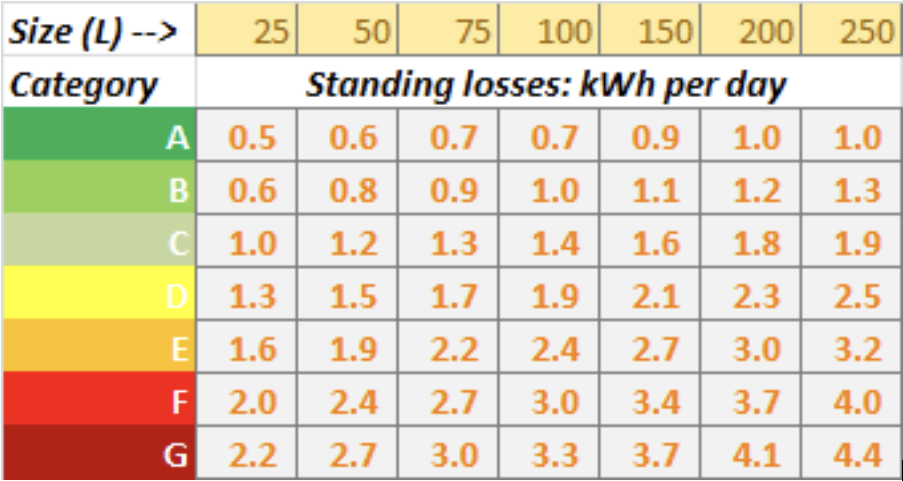
If you have one of these modern geysers it may have an energy category on the side with a letter from A to G. If you’re geyser is rated A it is very efficient and very green, all the way down to G which is very inefficient. These categories depend on a test and little formula from SABS/SARS.
Standing Losses = F + xV0.4
Don’t worry, we’re not going to dive into that… instead I’ve put the results of that calculation in the table at the bottom.
I have a 200L tank that is category E – so my geyser uses 3.0kWh per day, just keeping itself warm – regardless of whether I use ANY hot water. If you don’t have an energy rating on your geyser, it’s probably pretty low down. Very old ones and ones stored outside will be much worse even than these figures – but to be on the safe side, just assume they are category G — e.g. so if I have an old 200L geyser, it probably uses a little more 4.1kwh/per day staying hot. Luckily I’ve got a more efficient one than that and only use 3.0 units/day.
Current rate per kWh is R 3.50. So that would equate to R 10.5 per day, or R 315 per month.
2: Electricity cost related to usage.
The first step is figuring out how much hot water you use. Most of your hot water is probably used when showering or bathing.
Using data from the App, I can work out that I use around 100L of hot water per day, that’s from showering, bathing the kids, washing up etc. My hot water is set to 60 degrees, I can see that on my geyser. That’s all I need to know for this bit. Using a bit of science the amount of energy I use up in the hot water is:
• 100 Litres of water is the same as 100 kilograms of water
• Hot water is 60 degrees, and cold water is around 15 degrees – so I want to heat it up by 45 degrees (60 minus 15)
• The ‘specific heat capacity’ of water is 4.2 KJ/kg/Degree — don’t worry if you don’t understand what this is, but we need it to convert the degrees-C and kilograms of water into how much energy we need (it’s the same for all water everywhere, as long as it’s not turned into steam or ice!)
• The calculations goes: 100 x 45 x 4.2 = 18,900 Kilo Joules of energy
• We normally see energy in our electricity meter and bill as kilo-watt hours, rather than kilo-joules, so we have to divide by 3,600 (the number of seconds in an hour) to convert them — so 18,900 KiloJoules is 5.25 kilowatt-hours (18900 ÷ 3600 = 5.25)
So basically I use 5.25 electricity credits every day heating up water, this would be added to the amount for keeping the water hot while not in use (standing losses shown above).
Combining the numbers
To work out how much your geyser uses you need to just add the two numbers that we’ve worked out:
5.2 kwh/day for actual hot water (down the drain!) + 3.0 kwh/day for keeping it hot (in my airing cupboard!) = 8.2kwh/day
So looking at a month, we need to multiple by the number of days – 8.2 x 30 days = 246 kwh/month
And finally to convert that to Rand, we need to multiply by the cost per unit of electricity. City of Cape Town prepaid tariff is R 3.50 per kWh for the first 600 kWh and then R 4.27 per kWh after the 600 kWh within the month. For sake of example I will use the lower rate.
So finally I take 246kwh/month and multiply by 3.5 to get R 861. I spend R 861 each month on hot water, an average of R 28.70 per day.
Fixed rate per litre from heat pump
As this is a fixed rate based on usage only, there is an easy calculation.
100 litres per day multiplied by R 0.13 = R 13 per day
3000 litres per month = R 390 per month.
This would equate to a saving of R 471 (54%) per month if we I use 100 litres of hot water per day.
If I had to use 200 litres per day, a geyser would cost R 47.25 per day vs R 26 per day on the fixed rate, therefore a R 637.50 (45%) saving per month.